

.png)
Industrial stormwater best management practices (BMPs) focus on minimizing pollutants in stormwater runoff. Site operators typically rely on structural components to manage stormwater. What does this mean for the average facility? How can you incorporate working stormwater control methods for industrial facilities at your current location? Let's take a closer look.
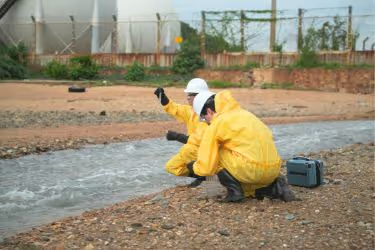
Your Industrial Site Needs a Stormwater Pollution Prevention Plan (SWPPP)
Developing and meeting SWPPP requirements lets your site comply with environmental laws. It prevents water pollution by significantly reducing the risk of introducing metals, oils, and chemicals into local water bodies. Maintaining a SWPPP is not just a good idea; the EPA and Washington Department of Ecology mandate it. The Clean Water Act, in conjunction with the EPA's National Pollutant Discharge Elimination System (NPDES), outlines the requirement for a prevention plan when there is a possibility that your site may discharge stormwater.
How the SWPPP Protects Your Business
Being proactive is significantly less expensive than dealing with water contamination once it occurs. Prevent chemical spills from spreading and contaminating nearby water. Failure to do so can result in fines.
Ensuring MSGP Compliance
Your multi-sector general permit (MSGP) for stormwater discharges is issued under the NPDES. It allows your facility to discharge stormwater if you follow stringent pollution prevention and monitoring requirements. This is where the SWPPP comes in. It ensures compliance by spelling out the stormwater control methods for industrial facilities you rely on. Additionally, compliance depends on spill prevention, water sampling, routine infrastructure inspections, and meticulous record keeping. There are several considerations.
Source Control for Industrial Sites
How will you prevent pollutants from entering the stormwater in the first place? This task aims to identify the source of any potential pollution rather than focus on subsequent cleanup when the spill occurs. Steps involved include:
- Good housekeeping. Develop protocols for regular cleaning of exterior areas and for removing trash and debris. Additionally, procedures for the immediate cleanup of chemical spills should be included.
- Spill prevention. Establish physical barriers to prevent chemicals from spreading. Examples include drip pans, sealed storage containers, and ready-to-use spill kits.
- Employee training. Every employee must know how to implement stormwater control methods for industrial facilities. Training should cover safe material handling, immediate spill response, and adherence to BMPs.
Stormwater Monitoring Benchmarks
Develop a system for measuring concentration levels of specific pollutants in your site's stormwater discharge. These benchmarks tell you immediately if your BMPs are working and where there is room for improvement. Typical measurements focus on pH levels, total suspended solids (TSS), and grease. Depending on your site's operations, you may need to add more measurements to your benchmark evaluation.
Spill Response Procedures
Formulate a step-by-step plan for containing and cleaning up chemical spills at your facility. These procedures should include notification protocols, containment using booms or barriers, and subsequent cleanup and disposal. In addition to having the plan in place, remember to have spill kits readily available at multiple storage sites. If your employees have to run across the facility to find a kit, the spill may already be beyond simple containment.
Stormwater Control Infrastructure
So far, we have discussed the need for documentation, proactive employee training, and BMPs with an eye on compliance. Now is the time to reassess the composition of your stormwater control infrastructure. Do you know its individual components?
Stormwater Detention Ponds
You may see them as dry ponds or detention basins in your facility's compliance documentation. Stormwater detention ponds reduce downstream flooding, slow runoff speed, and allow solids to settle before the water discharges into nearby streams or lakes. This type of pond is designed to drain within one to two days after significant rainfall. For these ponds to function as intended, expert technicians must regularly remove sediment and debris.
Stormwater Retention Ponds
Check your facility's paperwork for retention ponds, which may also be called wet ponds or stormwater management ponds. This type of infrastructure retains water to improve quality by letting pollutants settle. Unlike a detention pond, the retention pond never completely drains. It is supposed to maintain water at a specific level for its functioning. These ponds frequently rely on vegetation and water baseline levels to remain operational. The most common maintenance activities include regular sediment dredging and vegetation management.
Wet Vaults
Typically, an underground structure functions like a detention pond but is designed to serve as a permanent water reservoir. In your paperwork, it may be referred to as a wet pool. Placing them underground is a space-saving measure. The water is released in a controlled manner after trash and debris have had a chance to settle to the bottom. Regular debris removal is critical because these vaults are typically only three to five feet deep.

Bioswales
Industrial sites often utilize reinforced drainage channels lined with vegetation, rock, concrete, or riprap. These channels slow runoff and allow suspended solids to settle while reducing erosion. Maintenance involves sediment removal and clearing obstructions to ensure consistent water flow.
Is Your Stormwater Infrastructure in Good Working Order?
When was the last time the facility's stormwater infrastructure was inspected? Do you have documentation that gives you the findings of prior inspections? Most importantly, is there evidence that recommendations were followed up on? Many questions need answers to ensure that stormwater control at your industrial facility is in good shape.
Schedule it now if it has been a while since the last inspection. Technicians can use non-invasive inspection methods such as push cameras or hydro-jetting assessments to reveal potential problems like sediment buildup, grease blockages, root intrusion into pipes, joint separation, or collapsed sections. The advantage is clear: you know ahead of the next storm event if your stormwater infrastructure needs repairs. Catching problems early saves money and prevents a breakdown that can lead to environmental damage.
Typical Maintenance Recommendations After an Inspection
Industrial storm drain inspections are fully customizable to meet your facility's specific needs. Whether you have reinforced drainage channels in loading areas or sedimentation vaults near the parking lot, inspections not only identify problems but also provide solutions to restore the infrastructure to working condition.
- Oil-water separator (OWS) maintenance. These function by removing oil and hydrocarbons from water. Corrosion and buildup can hamper performance. Regular maintenance involves filter cleaning and sludge removal.
- Industrial detention pond cleaning. Technicians remove accumulated debris and sediment. They collect trash that floats on the water and dredge sediment from the bottom of the pond. An excavator may be necessary for deep sediment, while a hydrovac is sufficient for other types of removal. Regular maintenance also prevents blocked inlets or outlets.
- Storm pond remediation. Sediment buildup will reduce efficiency. Inspections measure the depth of sediment accumulation. Subsequent removal returns the pond to full function. Technicians may recommend additional steps based on your location's specific needs.
- Filter vault cleaning. Too much sediment or floating debris can reduce performance. Technicians ensure that pollutants removed from vaults are disposed of properly. Technicians also replace filters, typically every 2-3 years, to ensure the vault continues to successfully remove pollutants.
- Storm pipe cleaning. High-pressure water jetting effectively clears blockages caused by trash, leaves, grease, or other obstructions. The goal is to restore proper flow rates that deliver stormwater to different parts of the infrastructure. Cleaning the pipes also prevents localized flooding within the facility.
Putting it All Together With an Industrial Stormwater Training Checklist
By now, it is clear that stormwater control at industrial sites has multiple components. Because there are so many moving parts, getting started can seem daunting. Let's break it down into achievable steps that lead to guaranteed compliance and effective pollution prevention. These steps become part of your facility's industrial stormwater training checklist.
Begin by defining the regulatory requirements that your facility must comply with. They involve DOE, EPA, MSGP and NPDES. Create a chart of the main points. Next, connect these points to the development of the location's SWPPP. Spell out the BMPs you will implement and explain how your employees play a crucial role. The latter is essential because it is a tendency for workers to think that pollution prevention is solely the job of maintenance staff.

Define good housekeeping practices focusing on chemical storage, spill prevention and control, and trash management. While each employee must do their part, your maintenance team is at the forefront of trash and debris management. Examples include not sweeping anything into storm drains and monitoring trash receptacles to prevent overflow. Partner with qualified industrial stormwater experts to meet benchmark requirements for ongoing stormwater sampling and monitoring.
All staff must be well-versed in source control measures and spill response procedures. Partnering with a team of expert technicians is crucial to inspecting and maintaining stormwater control structures effectively. Do so before the next storm event to ensure all systems are fully functional. Do not wait until storm drains back up to seek help.
What a Professional Partnership With Expert Stormwater Maintenance Professionals Looks Like
Several components define this type of partnership.
- Choose experienced teams. Getting it right the first time is critical when processes involve pollution control and prevention. Avoid untested providers when compliance is on the line.
- Demand thorough inspections and mapping. Compliance affects all elements of your stormwater system. Work with a team that can handle maintenance and cleaning procedures for the entire system – not just the pipes.
- Find local experts who handle compliance support. If compliance-related paperwork seems daunting, consider outsourcing this task to qualified professionals. They should provide compliance certifications, maintain proper documentation for your facility, and help your site remain audit-ready.
Where can you find this type of storm drain cleaning service near me? Easy! CatchAll Environmental focuses on pollutant removal and control with comprehensive cleanings and innovative solutions. Additionally, we can establish a regular inspection schedule that enables you to focus on other tasks necessary for running your facility.
Give us a call today!